GEOS
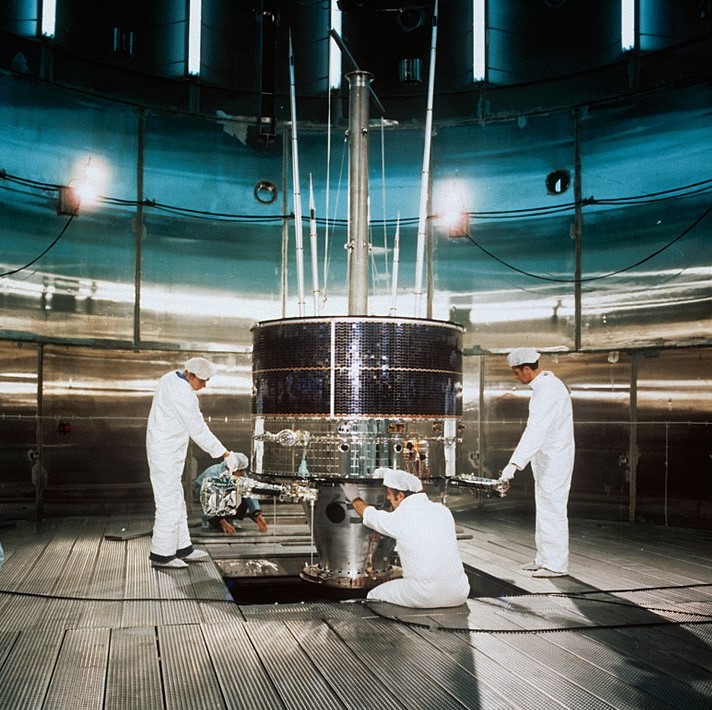
Geos was designed for geostationary orbit to study the particles, fields and plasmas of the Earth's magnetosphere using seven instruments provided by ten European laboratories. Because of its unique orbit and the sophistication of its payload, Geos was selected as the reference spacecraft for the worldwide 'International Magnetospheric Study'. Unfortunately, Geos-1 was left in a low transfer orbit following launch in 1977 because of a problem with its US Delta launcher. As a result, the Qualification Model was launched as Geos-2 in 1978 with an identical payload and successfully reached the planned orbit. In spite of its orbit, Geos-1 made a significant contribution to IMS (International Magnetosperic Study), and its mission formally ended on 23 June. Geos-2 was highly successful, creating a huge database for magnetospheric studies and plasma research in general.
Main goals of the mission :
- an advanced knowledge of the dynamics of the magnetosphere, in particular to study the response of the near-Earth environment to varying conditions in interplanetary space (nominal objective reached with GEOS-2).
- Study of the dayside sector of the magnetosphere: the plasma bulge and the plasmapause have been investigated in detail (GEOS-1).
Access to mission data |

|
Access to mission documents |

|
Data per experiments
Here you can access data of each experience archived on this site:
CONJ-PTS, GROUND, S300-ULF, S331-MAG.
News and useful links
More information, including mission descriptions, can be found at ESA Website and NASA GEOS-2
Other links: ESA GEOS-2,
ESA GEOS-1