VENUS Express
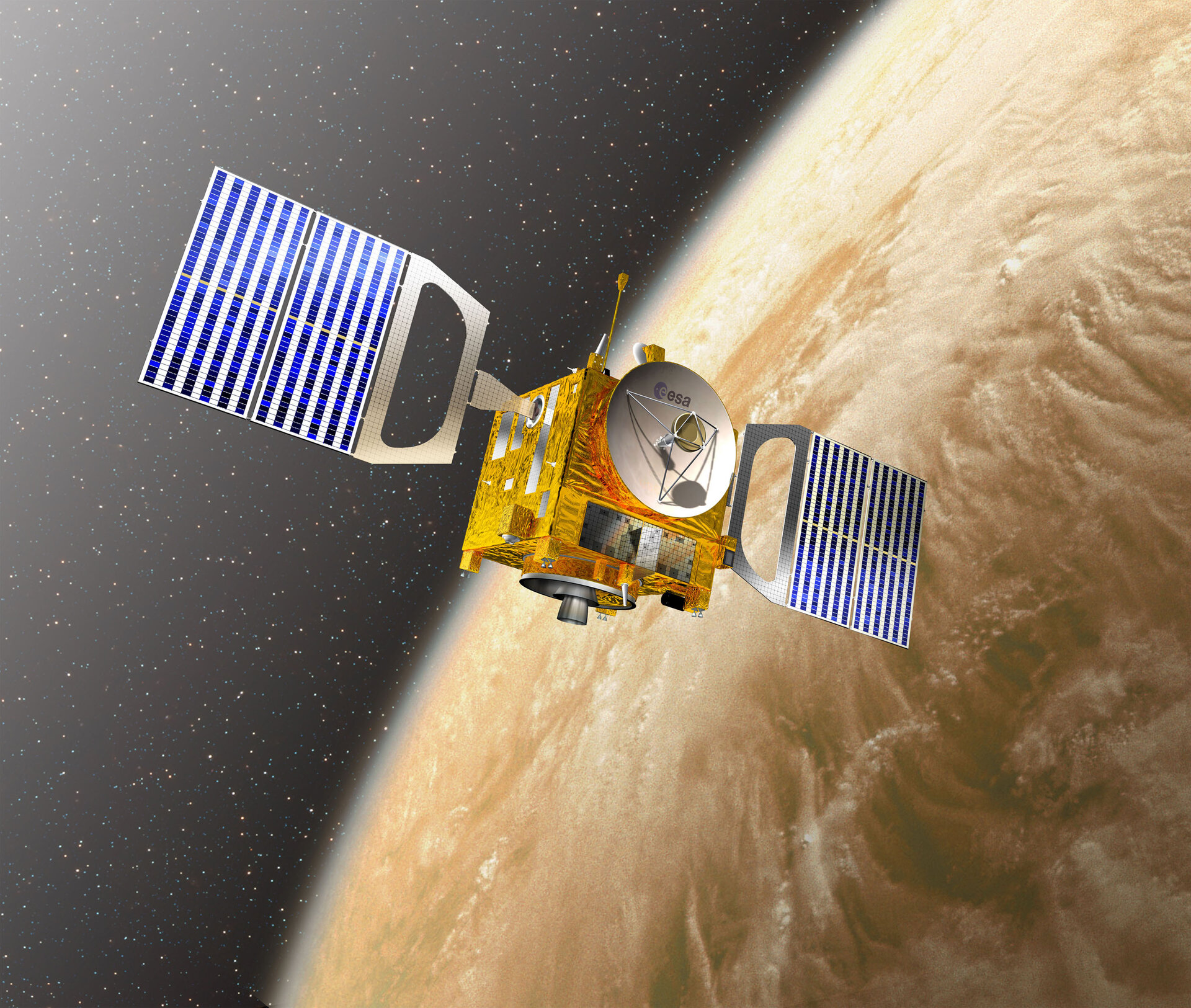
In November 2005, the ESA launched the Venus Express probe in order to better understand the planet Venus which, although close to the Earth, remains largely unknown because of its opaque cloudy atmosphere. The probe, which arrived in orbit around Venus in April 2006, had the primary mission of analyzing the planet's atmosphere in order to determine its composition and dynamics. Another goal was to study if there was volcanic or even seismic activity. These measurements could eventually help to understand why the destiny of Venus, whose surface temperature is around 460°C, was so different from that of the Earth.
Since the launch of the mission, Venus Express has achieved several important results such as the detection of sulfur dioxide in the upper atmosphere or the confirmation of the existence of a double cloudy vortex above the south pole of Venus.
To carry out these measurements, Venus Express had seven instruments, including the Aspera-4 plasma analyzer developed by IRAP in Toulouse.
On November 16, 2014 Venus Express completed its eight-year mission, well over its expected lifespan. The probe having exhausted its fuel, this will lead to its destruction when it re-enters the dense layers of the atmosphere.
Access to mission data |

|
Access to mission documents |

|
Data per experiments
News and useful links
More information, including mission descriptions, can be found at UCLA Website and UIOWA Website.
Other links: NASA Website,
JPL Website